When homeowners decide to compare floating vanities vs traditional cabinets for modern bathrooms, the choice goes far beyond aesthetics. Floating vanities are projected to see 15-20% year-over-year sales growth in 2026, reflecting a clear shift in how San Diego homeowners think about bathroom design, space, and long-term value.
| Question | Quick Answer |
|---|---|
| Which style looks more modern? | Floating vanities have a cleaner, more contemporary look and dominate current design trends. |
| Which is more affordable? | Traditional cabinets typically cost $300-$800 less to install because they don’t require wall reinforcement. |
| Which offers more storage? | Traditional floor-mounted cabinets generally provide more enclosed storage capacity. |
| Which is easier to clean? | Floating vanities are easier to clean underneath since the floor is fully accessible. |
| Which is better for small bathrooms? | Floating vanities create the visual illusion of more space, making them ideal for compact rooms. |
| Do I need a professional to install a floating vanity? | Yes. Floating vanities require structural wall blocking, plumbing adjustments, and precise mounting that demands professional installation. |
| Where can I get expert help in San Diego? | The team at Mercury Builders handles custom bathroom renovation from design through construction. |
Why Comparing Floating Vanities vs Traditional Cabinets Matters in 2026
The bathroom has become one of the highest-priority rooms in any home renovation project. Homeowners in 2026 are investing more thoughtfully in this space, and the vanity is often the centerpiece of that investment.
Choosing between a floating unit and a traditional cabinet affects your floor space, your cleaning routine, your plumbing layout, and your home’s resale value. Getting this decision right from the start saves you time, money, and the frustration of a poorly planned renovation.
Just like choosing between a patio and a deck for your outdoor space requires careful thought about function and lifestyle, choosing between floating and traditional bathroom storage requires the same level of planning. Both decisions shape how you experience your home every single day.
What Are Floating Vanities? Defining the Wall-Mounted Option
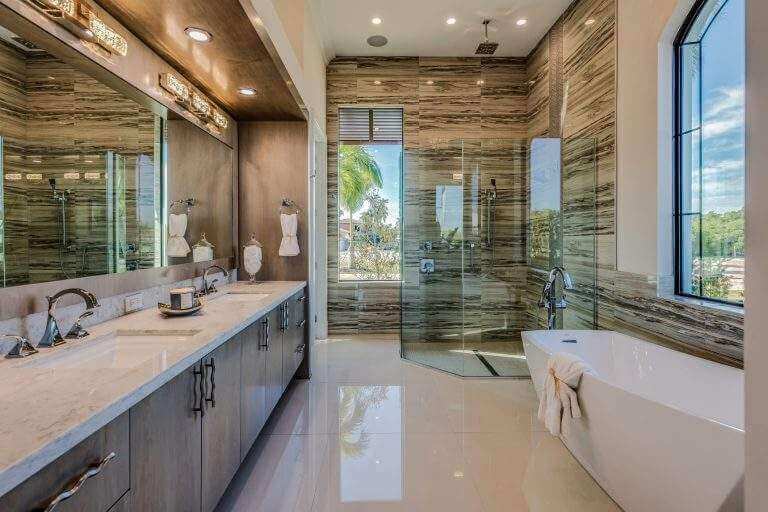
A floating vanity, also called a wall-mounted vanity, is attached directly to the bathroom wall with no contact between the cabinet and the floor. The gap beneath the unit is left open, which is what gives this style its signature airy, modern appearance.
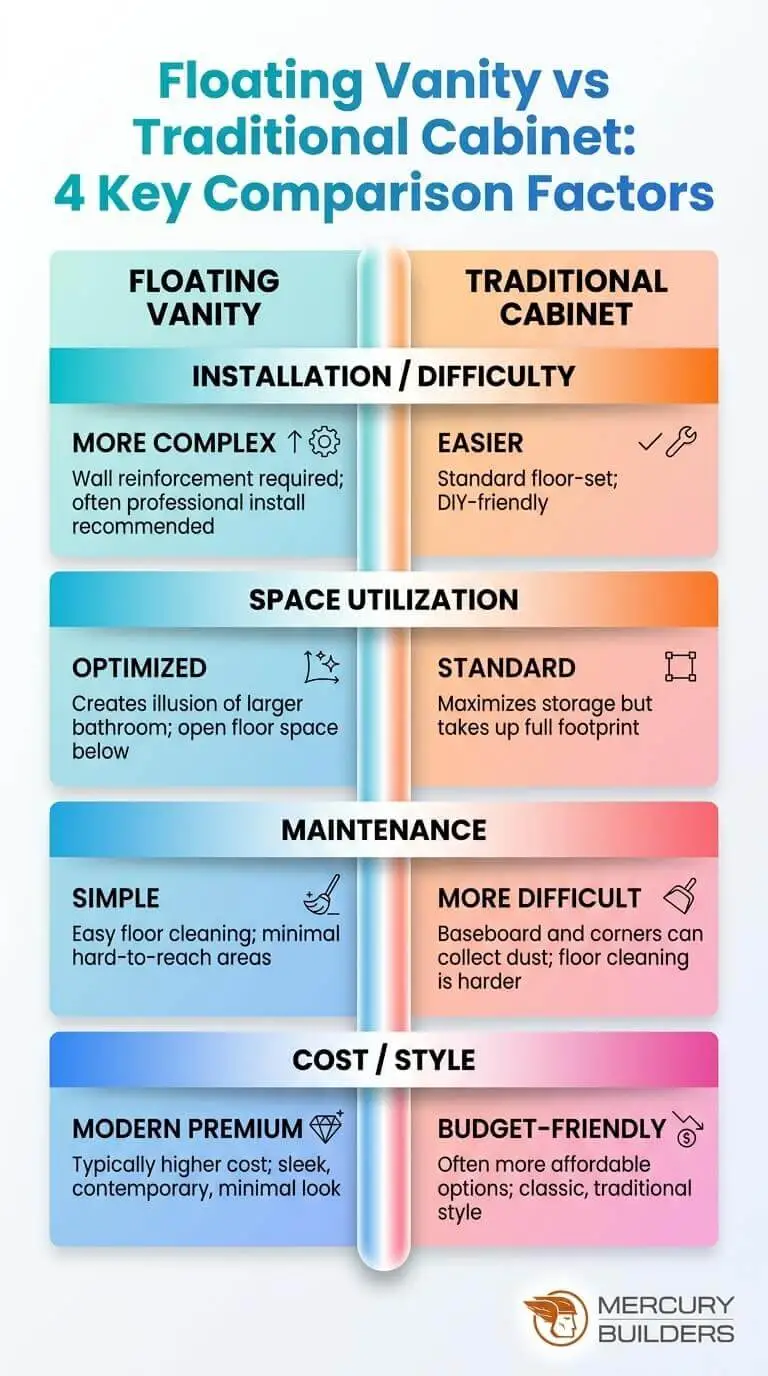
The installation requires the wall to be reinforced with structural blocking inside the wall cavity, ensuring the unit can bear the weight of the countertop, sink, and everything stored inside. This is not a DIY-friendly process, and it’s one reason why professional construction is strongly recommended.
Floating vanities come in a wide range of sizes, finishes, and configurations. In 2026, popular options include matte white lacquer, warm walnut wood tones, and concrete-look laminates that pair well with large-format floor tile.
What Are Traditional Cabinets? Understanding the Floor-Mounted Standard
Traditional bathroom cabinets sit directly on the floor and are either freestanding or built into the wall like a standard piece of furniture. They have been the default choice in residential bathrooms for decades, and for good reason.
Traditional cabinets are structurally self-supporting, which means installation is significantly simpler. They don’t require wall reinforcement, and plumbing connections are straightforward since the pipe runs are already planned for floor-level configurations.
According to current renovation data, floor-mounted and built-in traditional models still hold a combined 88% share of the bathroom cabinet market in 2026, compared to just 11% for floating styles. This tells us that traditional cabinets remain the practical choice for the majority of homeowners, even as floating designs grow in popularity.
Floating Vanities vs Traditional Cabinets for Modern Bathrooms: Cost Breakdown
Cost is one of the most important factors when you compare floating vanities vs traditional cabinets for modern bathrooms. Installing a floating vanity typically costs $300-$800 more than a traditional model, primarily because of wall reinforcement and plumbing relocation requirements.
Here is a clear comparison of the typical cost factors involved in each option:
| Cost Factor | Floating Vanity | Traditional Cabinet |
|---|---|---|
| Unit Cost (mid-range) | $600 – $2,500+ | $400 – $1,800+ |
| Wall Reinforcement | Required ($200-$500) | Not required |
| Plumbing Adjustments | Often needed ($150-$400) | Minimal to none |
| Labor Complexity | High (professional required) | Moderate |
| ROI on Resale | ~74% recoup | ~68% recoup |
Mid-range bathroom renovations involving modern vanity upgrades recoup approximately 74% of their cost upon home resale, making a floating vanity a worthwhile long-term investment for homeowners planning to sell.
When budgeting for your renovation, always factor in the full scope of the project, not just the unit price. A skilled construction team will give you a transparent, itemized estimate so there are no surprises.
Storage, Functionality, and Daily Use: Which Option Wins?
When you compare floating vanities vs traditional cabinets for modern bathrooms from a pure storage perspective, traditional cabinets hold the advantage. The floor-to-countertop enclosed space gives you more cubic feet of usable storage for toiletries, cleaning supplies, and towels.
Floating vanities, on the other hand, trade some storage volume for a cleaner visual profile and easier floor cleaning. Many homeowners compensate by adding recessed wall niches, side cabinets, or above-mirror storage to maintain functionality.
- Floating vanity strengths: Easier cleaning, open floor space, customizable height, modern look
- Traditional cabinet strengths: More enclosed storage, simpler installation, lower cost, proven durability
- Floating vanity weaknesses: Higher installation cost, limited under-sink storage, requires wall reinforcement
- Traditional cabinet weaknesses: Harder to clean underneath, visually heavier, less flexibility on height
Think of it this way: just like deciding between a hardscape-heavy patio design and a softscape-focused landscape plan for your outdoor space, the right bathroom storage choice depends entirely on how you use the room day-to-day.
How Wall Space and Structural Considerations Shape Your Decision
The wall behind your vanity plays a critical role in determining which option is feasible for your specific bathroom. For floating vanities, the wall must contain blocking (a horizontal piece of lumber installed between studs) to distribute the load safely across multiple anchor points.
In older San Diego homes, the walls may not be positioned or constructed in a way that makes floating installation straightforward. A qualified construction professional will assess your wall framing during the initial consultation to identify any structural challenges before work begins.
Traditional cabinets have no such wall requirement since their weight is carried entirely through the floor. This makes them far more adaptable to different wall types, including tile-covered walls, older plaster construction, and walls with irregular stud spacing.
Just as hardscape elements like retaining walls and paved paths require precise engineering to hold their position over time, a wall-mounted vanity demands the same level of structural attention. Never cut corners on the wall preparation phase of a floating vanity installation.
Best for Small Bathrooms: Comparing Floating Vanities vs Traditional Cabinets
For bathrooms under 50 square feet, the visual weight of your vanity choice makes a significant difference. Floating vanities visually “lift” the room because the exposed floor plane creates depth, making compact spaces feel more open and less cramped.
Research from 2026 shows that 47% of bathroom renovators choose vanities 48 inches or smaller, and in this size range, floating designs are most effective at creating the illusion of additional space. Paired with large-format floor tiles and recessed lighting, a floating vanity can make a powder room feel twice as spacious.
Traditional cabinets in small bathrooms are not a bad choice, but they do require thoughtful design to avoid making the space feel boxed in. Choosing a lighter finish, a simple door profile, and an integrated sink can mitigate the visual heaviness of a floor-mounted unit.
“Your home should reflect your lifestyle, personality, and evolving needs. Nowhere is that more true than in the bathroom, where the right vanity can shift the entire feel of the room.”
Renovation Style and Aesthetic Fit: Matching the Vanity to Your Home
When you compare floating vanities vs traditional cabinets for modern bathrooms, aesthetic compatibility with the rest of your home matters. Floating vanities are the natural fit for contemporary, minimalist, and Scandinavian-influenced interiors that prioritize clean lines and open space.
Traditional cabinets work beautifully in transitional, craftsman, coastal, and classic design schemes. A well-crafted Shaker-style cabinet with brushed nickel hardware can look just as intentional and refined as a sleek floating unit in the right setting.
Think about your home as a whole. Just as your outdoor landscape and hardscape choices should complement your home’s architecture, your bathroom vanity should feel like a natural extension of your overall design language rather than an afterthought.
If you are planning a broader renovation that includes multiple rooms, the bathroom vanity decision becomes part of a larger conversation about your home’s style direction. Our team helps you look at the full picture before committing to any single element.
Accessibility, Aging-in-Place, and Long-Term Livability
One of the most compelling reasons to choose a floating vanity in a modern bathroom renovation is the flexibility it offers for accessibility. Because the unit mounts directly to the wall, the height can be customized to suit the homeowner’s specific needs, including lower heights for wheelchair users or taller configurations for taller individuals.
The open floor clearance beneath a floating vanity also makes wheelchair approach significantly easier, which is why floating designs are central to the growing aging-in-place and universal design movement. This is a practical consideration that many homeowners overlook until later in life when mobility becomes a factor.
Traditional floor-mounted cabinets are fixed at a standard height and provide no under-sink clearance for mobility aids. If accessibility is a current or future priority, the investment in a floating vanity, despite the higher construction cost, is one of the most thoughtful choices you can make for your home.
What a Professional Builder Recommends for Your Modern Bathroom
As a design-build contractor serving San Diego County, we have installed hundreds of vanities across both styles. Here is our honest recommendation: the right choice depends on your specific bathroom dimensions, your renovation budget, your style preferences, and how long you plan to stay in the home.
For homeowners planning to sell within five years, a floating vanity in a clean, neutral finish adds visual impact that photographs beautifully and appeals to buyers. For homeowners who prioritize storage, practicality, and budget, a well-crafted traditional cabinet with quality hardware delivers lasting value without unnecessary complexity.
As an experienced builder in San Diego, we always recommend starting with a professional consultation before purchasing any vanity unit. The wall configuration, plumbing rough-in location, and tile layout all affect which option is most feasible in your specific space.
- Choose a floating vanity if: You have a small bathroom, a contemporary design, accessible renovation goals, or you’re upgrading for resale
- Choose a traditional cabinet if: You need maximum storage, have a larger bathroom, prefer a classic aesthetic, or are working within a tighter renovation budget
- Consider both if: You’re doing a full bathroom gut renovation where the plumbing can be repositioned to accommodate either style
Our work extends well beyond bathrooms. From custom deck design and installation to full interior renovations, we bring the same level of care and precision to every project we take on.
We also handle landscape remodeling and complete outdoor renovation projects, including patio construction, hardscape design, and more. Whether your vision starts inside the bathroom or extends to your entire property, we handle it all under one roof.
Installation Process: What to Expect When Working With a Builder
Whether you choose a floating vanity or a traditional cabinet, the installation process should follow a clear, structured sequence. A reputable builder will walk you through each phase so you always know what is happening and why.
For floating vanity installations, here is what the construction process typically looks like:
- Initial consultation and wall assessment (stud location, blocking needs, plumbing position)
- Design approval and product selection (vanity unit, countertop, sink, faucet)
- Demo and prep (removal of old vanity, tile repair if needed)
- Wall blocking installation (structural reinforcement inside the wall cavity)
- Plumbing rough-in adjustment (repositioning drain and supply lines if needed)
- Vanity mounting and leveling (precise attachment to wall blocks)
- Countertop, sink, and faucet installation
- Final plumbing connections, caulking, and cleanup
For a traditional cabinet installation, steps 4 and 5 are typically not needed, which is why the cost and timeline are lower. The construction sequence moves faster, which can be a meaningful advantage if your bathroom is the only full bath in the home.
Our process is the same whether we’re building a new deck, completing a hardscape and landscape overhaul in your backyard, or installing a custom bathroom vanity. We plan every detail in advance, keep you informed throughout, and stand behind the finished work with a comprehensive warranty.
How to Compare Floating Vanities vs Traditional Cabinets for Modern Bathrooms
When you carefully compare floating vanities vs traditional cabinets for modern bathrooms, neither option is universally better. Each has a clear set of strengths that make it the right choice in different circumstances.
Floating vanities win on visual impact, accessibility, and small-space performance. Traditional cabinets win on storage, cost, and installation simplicity. Your job is to define what matters most in your specific bathroom, and our job as your builder is to help you execute that choice with precision and craftsmanship.
In 2026, the best bathroom renovation decisions come from honest conversations about budget, function, and long-term goals, not from following a trend. Whether your project involves a single bathroom, a full home renovation, a new patio, or a complete landscape and hardscape redesign, we approach every detail with the same standard of excellence.
If you are ready to move forward, we encourage you to reach out to our team for a no-obligation consultation. We will assess your space, discuss your vision, and give you a clear, transparent plan with no hidden fees and no gimmicks.
You can also browse our completed project portfolio to see the quality of our construction work firsthand, and visit our bathroom remodeling and design page to learn more about what a full bathroom renovation with Mercury Builders looks like from start to finish.